
Corpus Christi and
the Eagle Pub
500 years of shared history.
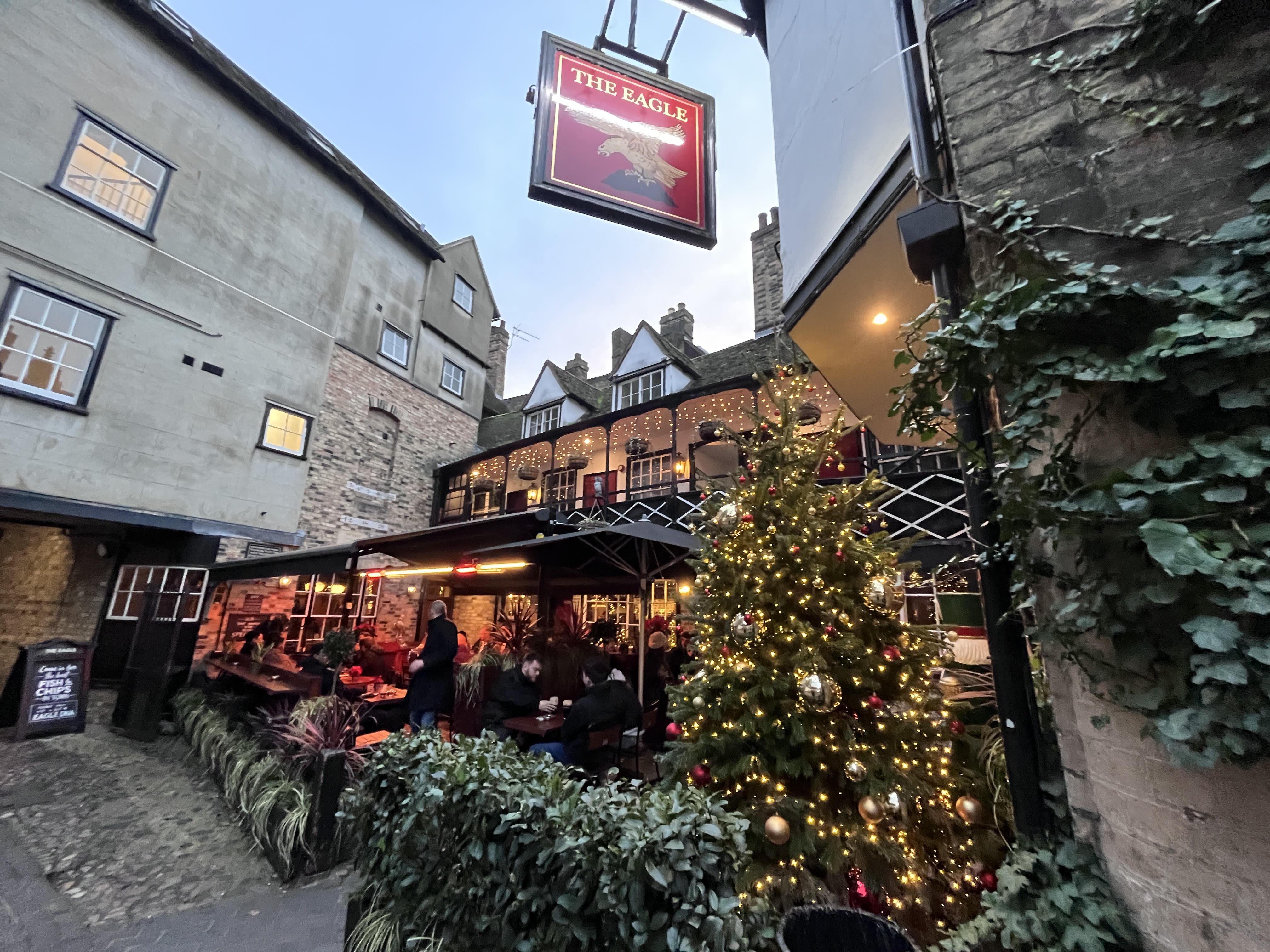

The second-oldest pub in Cambridge (the Pickerel Inn on Magdelene Street is thought to be oldest), and situated opposite the original entrance to the College, the Eagle Pub, run by Greene King, has a storied past and has become a Cambridge institution. This year marks the 500th anniversary of ownership by Corpus Christi College of The Eagle, so let’s take a look at its long association with the College.
According to Robert Masters’ history of the College (from 1753) to find out more we should look back to Peter Nobys who became Master in 1516. He moved on from the Mastership in 1523, but in 1525 he was appointed executor to one John Saintwary, and in that capacity paid the College £16 13s 4d to remember on 31 January both Saintwary and his friend and contemporary James Curson, who had given the College a house in the parish of St Bene’t. Masters says this gift was from the Executors of Curson, and was “probably the Inn called the Eagle and Child” (although he refers to it as the “Pelican and Young”.) All this was documented in an ‘Instrument’ of 16 July 1525.
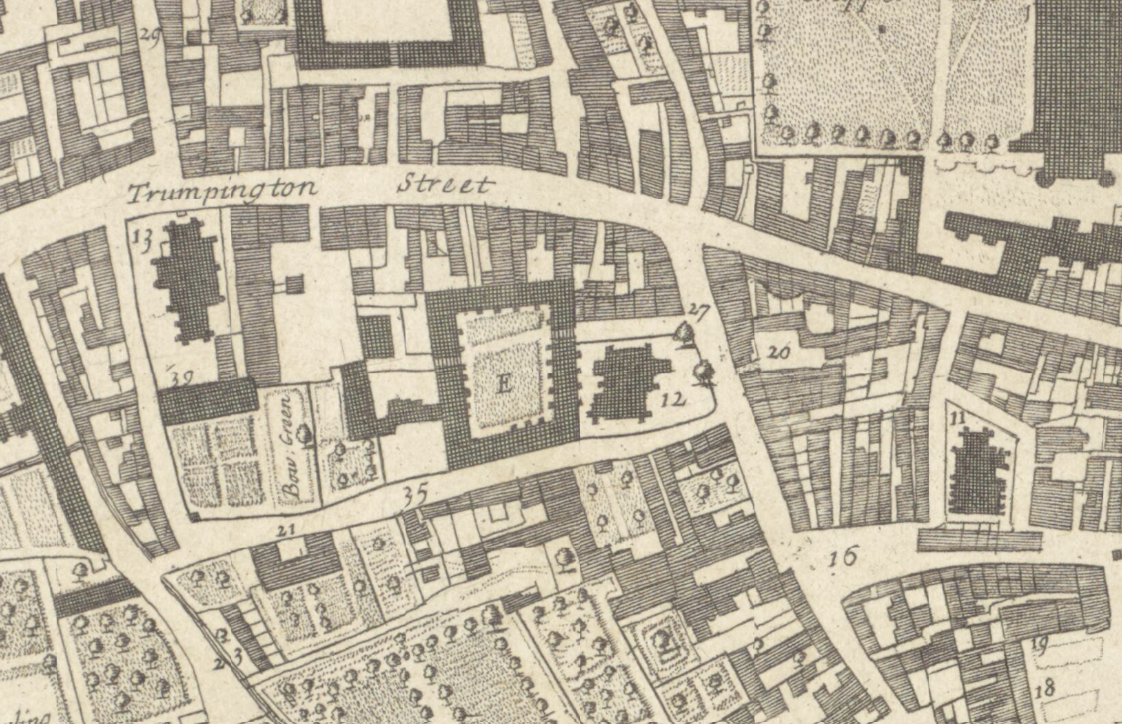
Exactly when the building became a pub is less clear. A lease to Andrew Pylkynton, innkeeper and his wife, in the College archives, dated 1566, mentions “…. their two tenements, a greater and a lesser nowe made an Inne called the Eagle and Child sett and built together in the parishe of St Benett in Cambridge.” During the next century it was completely rebuilt. In 1637 it was leased to a Mark Sherman for ‘a good fat gammon of bacon at audit time and a load of hay’. (A gammon of bacon in 1621 would have cost about two shillings.) Fast forward to 1667 - on the election of John Spencer as Master, it was agreed that a rent payable to the Master by the tenant of the Eagle and Child in lieu of hay could be used to enlarge and put wainscotting into the then Old Combination Room. The Eagle and Child was now opened as a coaching house. David Loggan’s 1688 map of Cambridge in depicts the inn and calls it ‘The Post House’, indicating that the innkeeper had acquired the contract to supply horses for postmen. (mail coaches, as opposed to mounted postmen, did not appear for another century.)
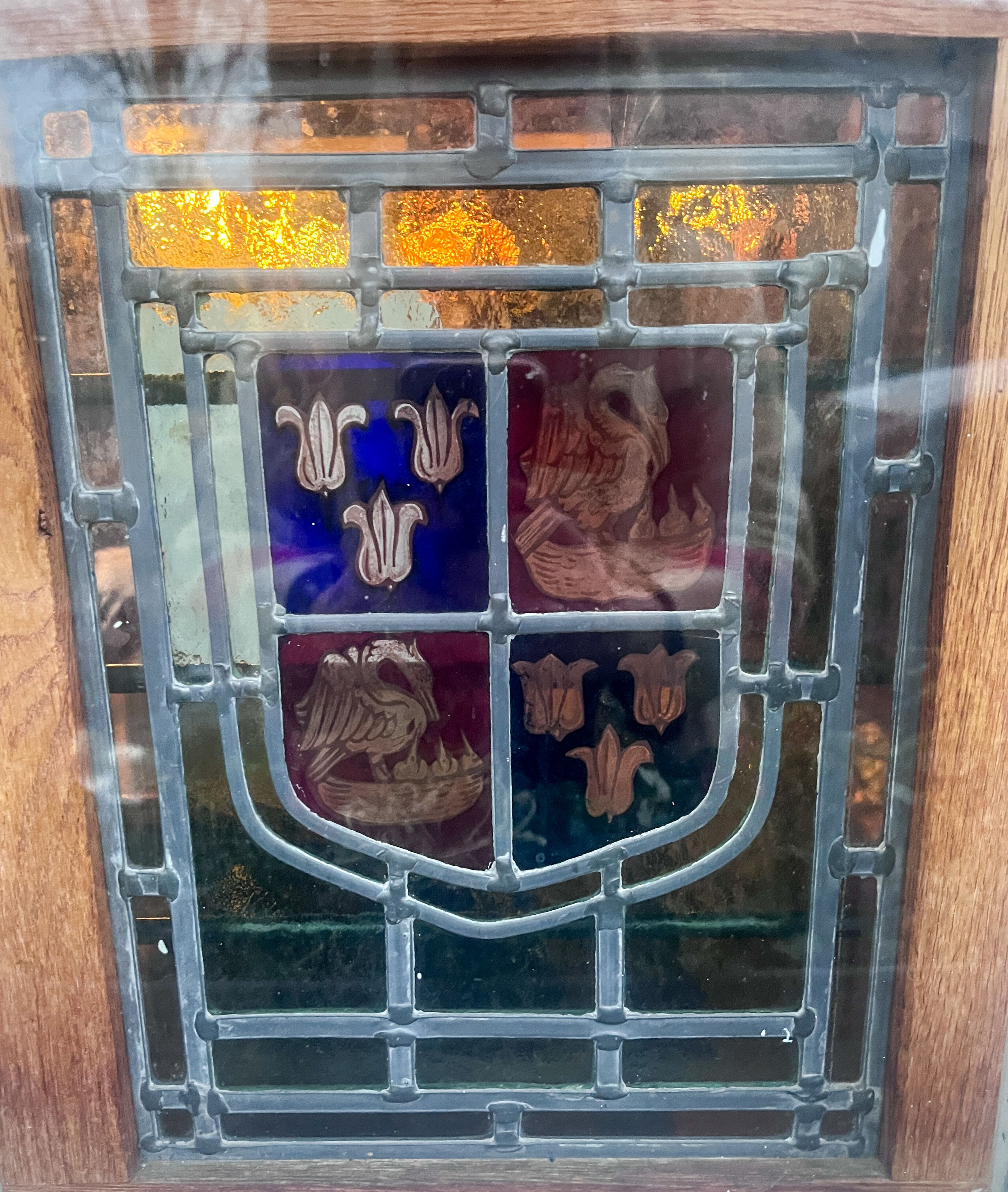
The Eagle and Child emblem comes from the crest of the Stanley family, the Earls of Derby. The story associated with it is the account of a family ancestor having abandoned and exposed an illegitimate son in an eagle’s nest, and the eagle having nurtured and fed him. Why this emblem was chosen is unknown. (There is also a pub in Oxford called the Eagle and Child; it was frequented by JRR Tolkien.)
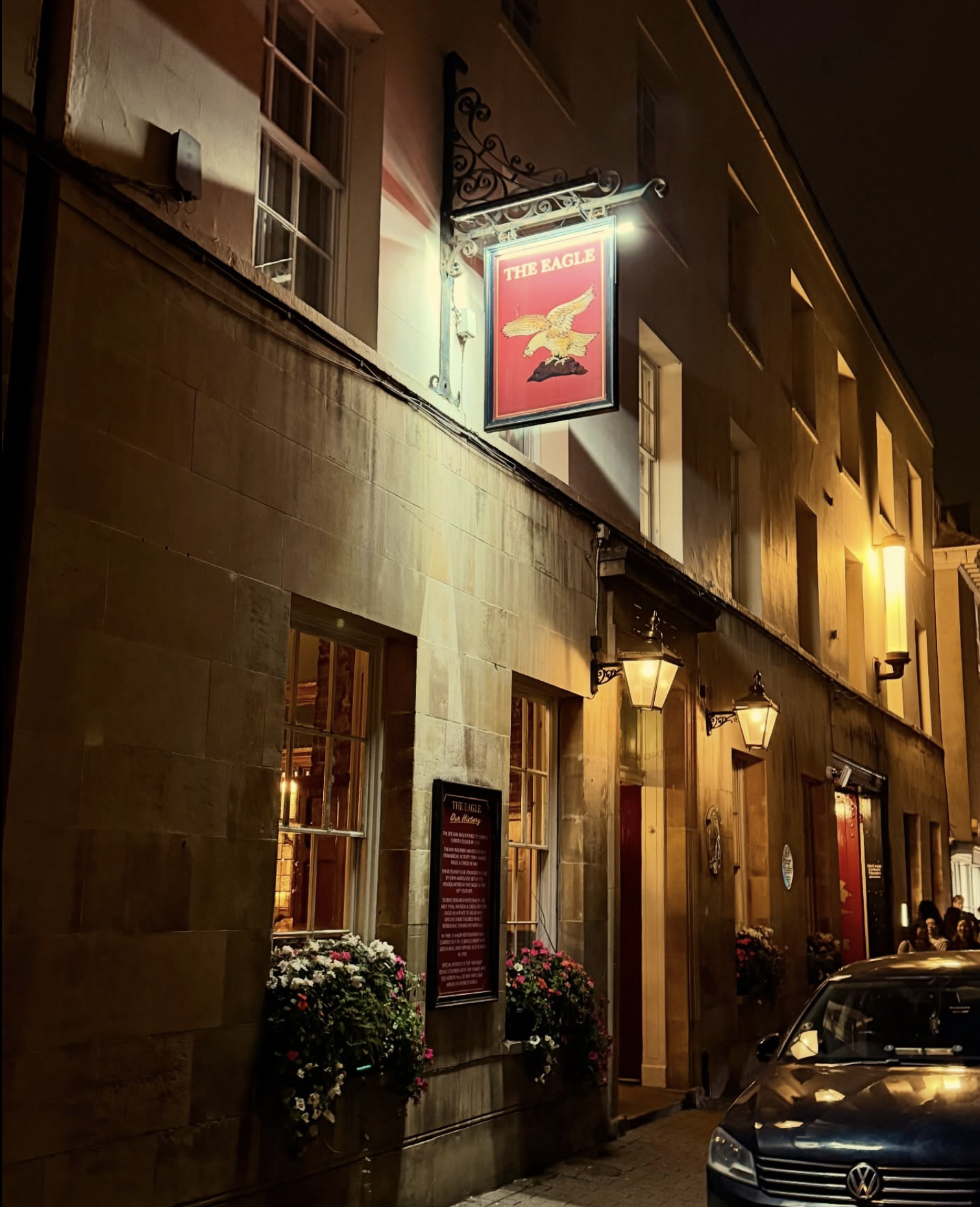
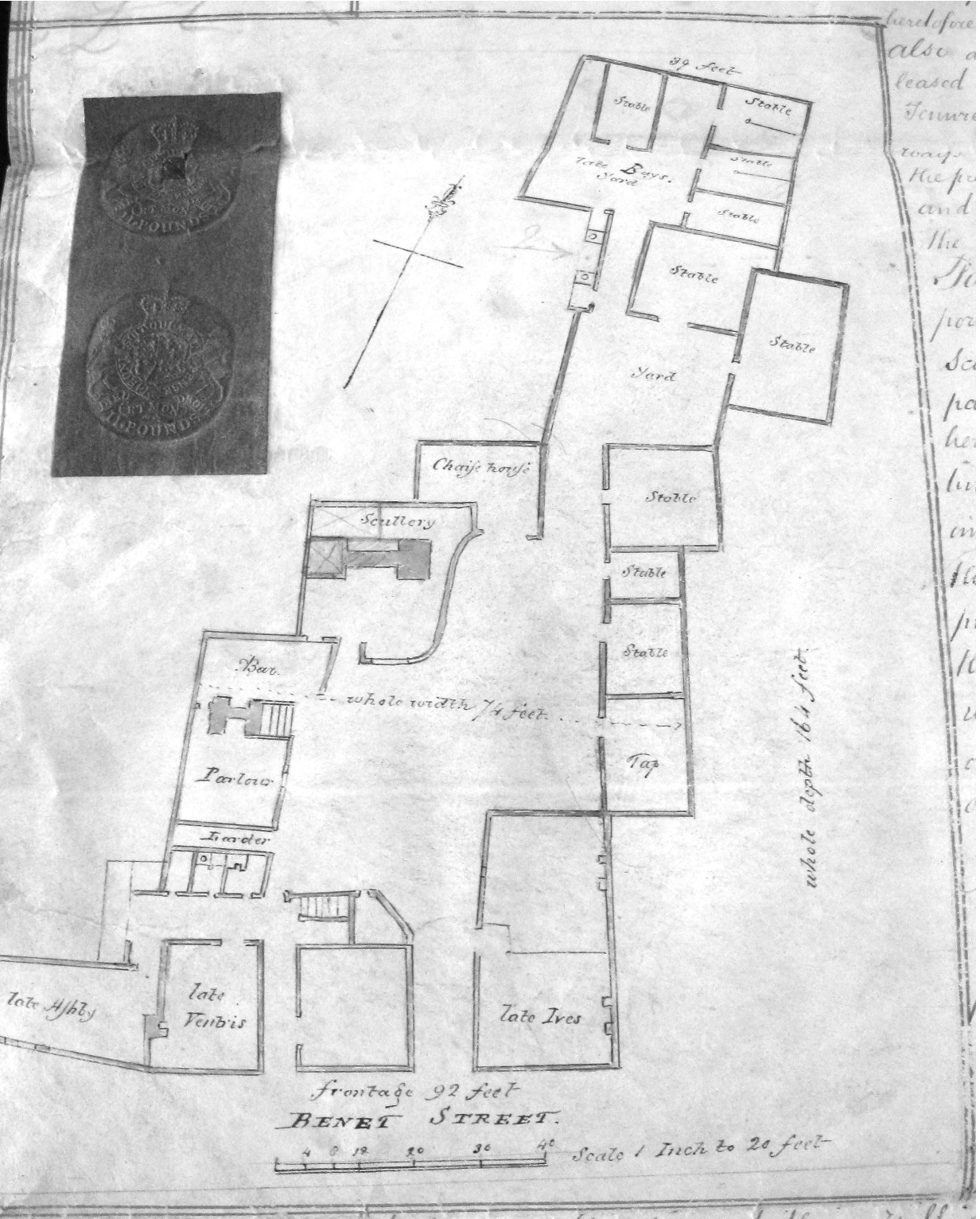
The pub sits at Number 8 Bene’t Street. Over time, Numbers 9, 7, and 6 have thought to have been incorporated into the inn.



Cambridge’s most famous watering hole
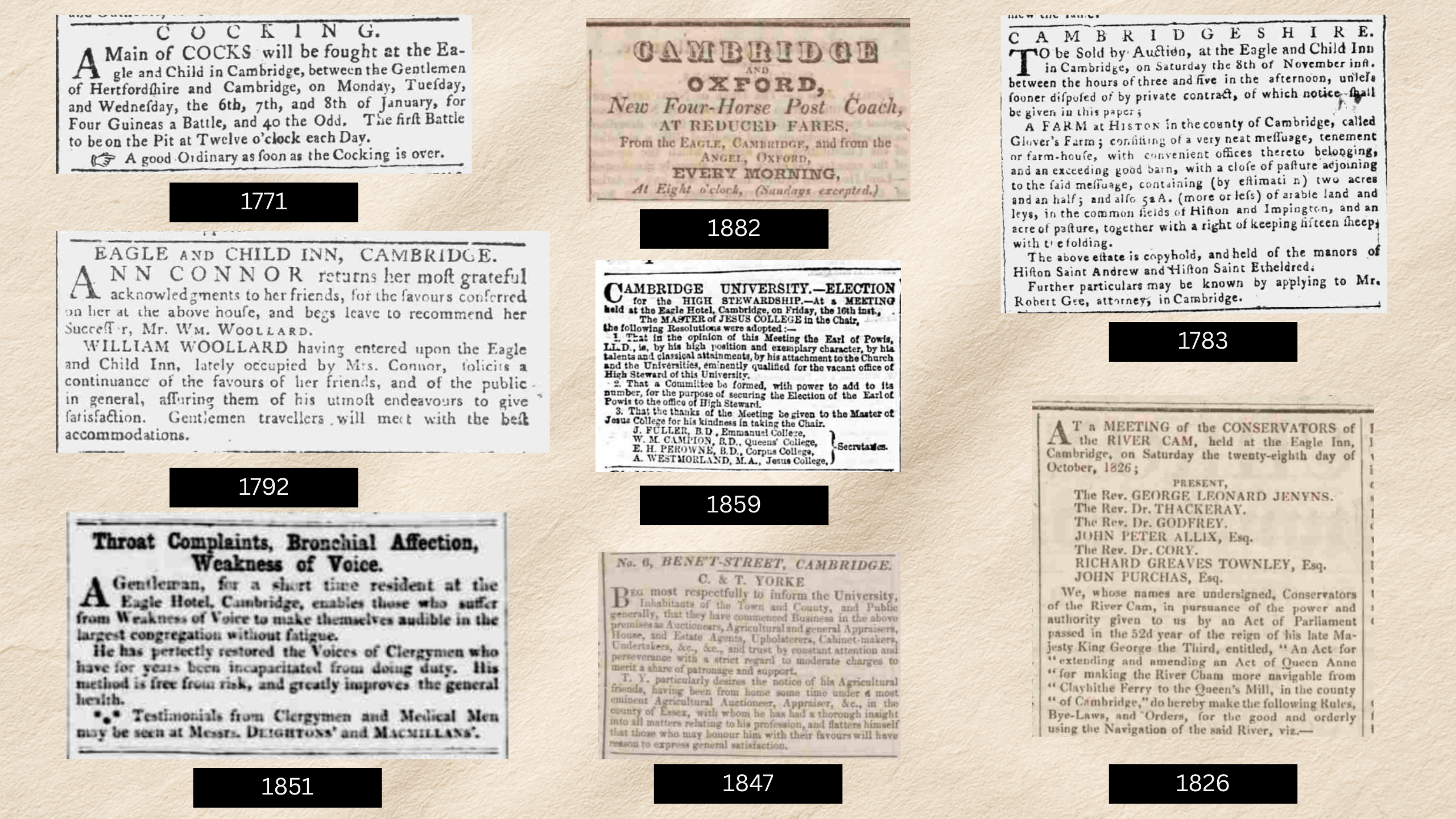
For the next few centuries the Eagle continued to built up a reputation as a fine coaching inn. By 1834, it was possible to board a superior fast coach to London for the sum of four shillings. The College lease books contain numerous entries showing publicans coming and going, changing lease terms, and rents collected. It was evidently a busy hostelry that served many other purposes, including as a meeting place for various University and local groups, an auction site, and as temporary accommodation for travelling salesmen, as shown by these clippings from various local newspapers.

During the 18th and 19th centuries the Eagle was a hub of political intrigue. In 1782 John Mortlock, an MP and 13 times Mayor of Cambridge, chose the Eagle as his political base and the dinner gatherings in the Eagle were known as the Rutland Club. Mortlock wove a web of bribery and corruption that was to hold Cambridge in its grip for almost half a century. He is famously quoted as saying, “That which you call corruption I call influence.”(1) Until well past the middle of the 19th century, the Eagle was still used as the headquarters for Cambridge Tories and was made full use of during elections.

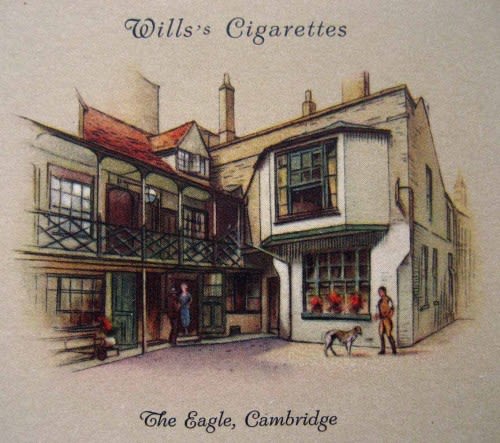
The coming of the railway in 1850 saw the Eagle lose its coaching status and the building was divided, with the rear becoming a tavern and the front a hotel. The hotel only lasted for a decade, when the building was converted into offices that were let out to Wild, Lewiston & Shaw, solicitors and estate agents.
The Eagle Lore

The open window
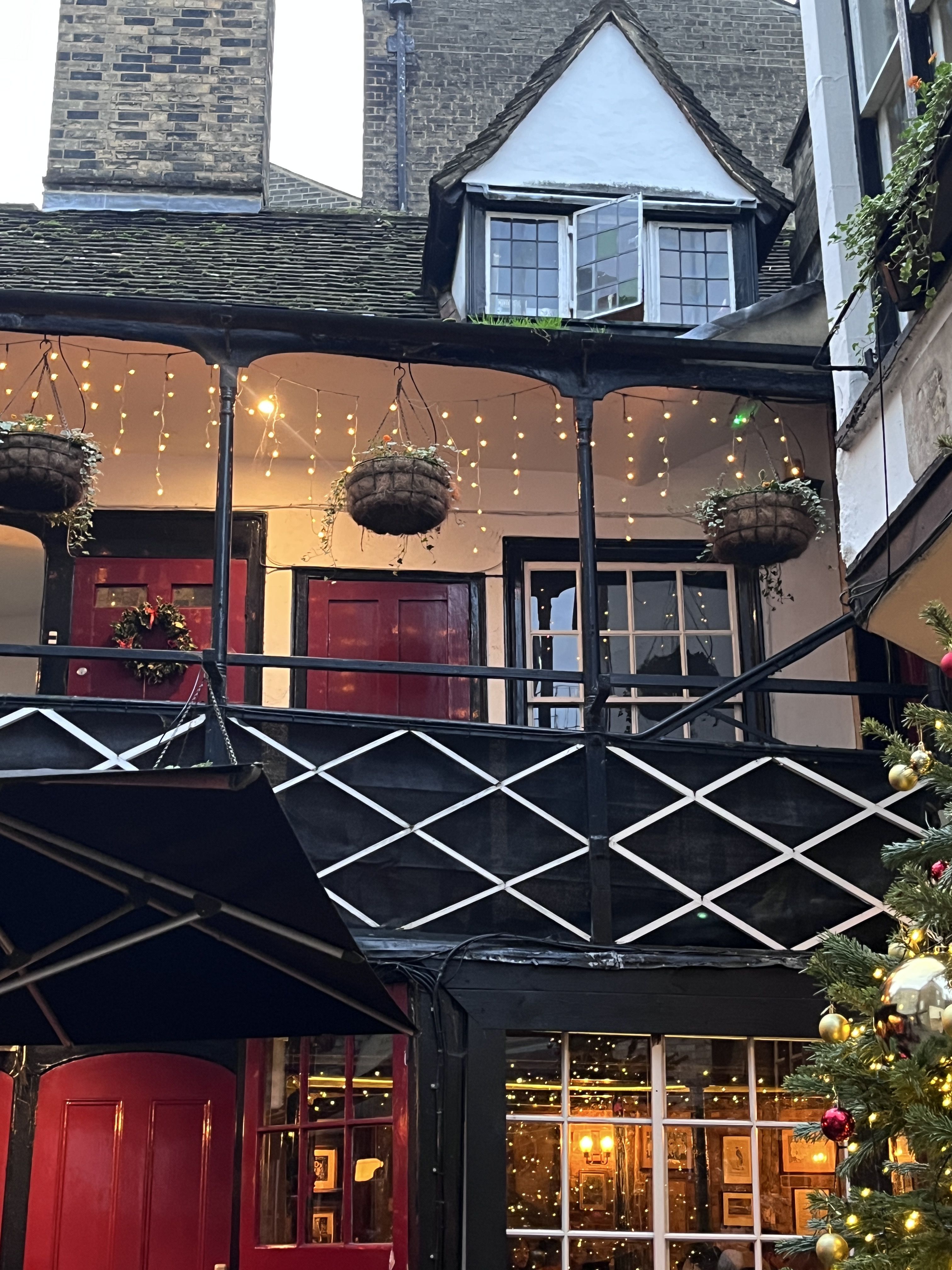
Cambridge is replete with ghost stories and the Eagle is no exception. It's said that a fire raged through the upstairs bedrooms a few hundred years ago and a young child, unable to open the window, was trapped inside. Ever since, the window has been kept open, and on occasions when it has been closed, it has brought bad luck, or has mysteriously opened itself.

The lost treasure
In 1826 two labourers, William Smith and Stephen Woodcock, discovered a haul of coins hidden underneath 9 Bene’t Street, next door to the Eagle. The treasure included nearly 200 pieces of gold and over 3,500 pieces of silver, none of a later date than the reign of Charles I. The College received £192 from the sale of the hoard, from which it gave £20 to the master mason and £5 each to the labourers.(2)

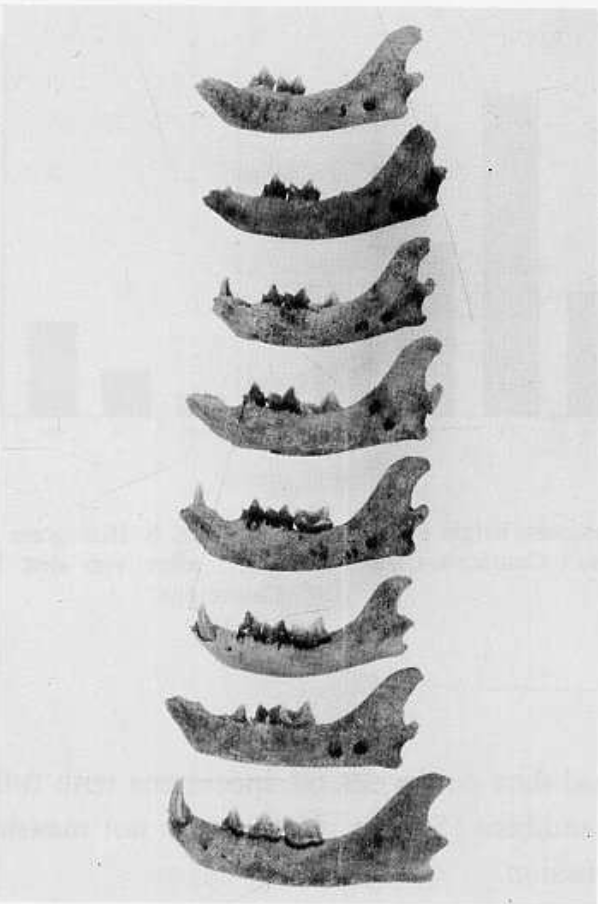
A well full of cats
In 1996, archaeological excavations in Eagle Yard revealed a 13th-century well with “a large collection of cat carcasses in the upper levels of the well shaft, apparently in a single episode”(3) The archaeologists believe the material “almost certainly” relates to the butchering of cats for their meat, although the skins may also have been used.
The RAF Bar and Ceiling
In 1942 the 8th Army Air Force came to England and many of the former RAF airfields became home to American Bomber and Fighter Groups. The young Allied and British airmen often came to Cambridge to relax at the American Red Cross Service Club at the Bull Hotel on Trumpington Street, and the nearby Eagle became a favourite. According to Malcolm Osborn, “it is believed in early It is believed that in late 1941 or early 1942, a young airman stood precariously balanced on a chair atop a table in the back bar, then using a candle he burned his Squadron’s number into the ceiling”.(5) This started a tradition that was to continue until the war’s end and beyond of graffiti written with lipstick, charcoal, candles and Zippos. The entries includes names and squadron numbers right up to the days of the Berlin Airlift.

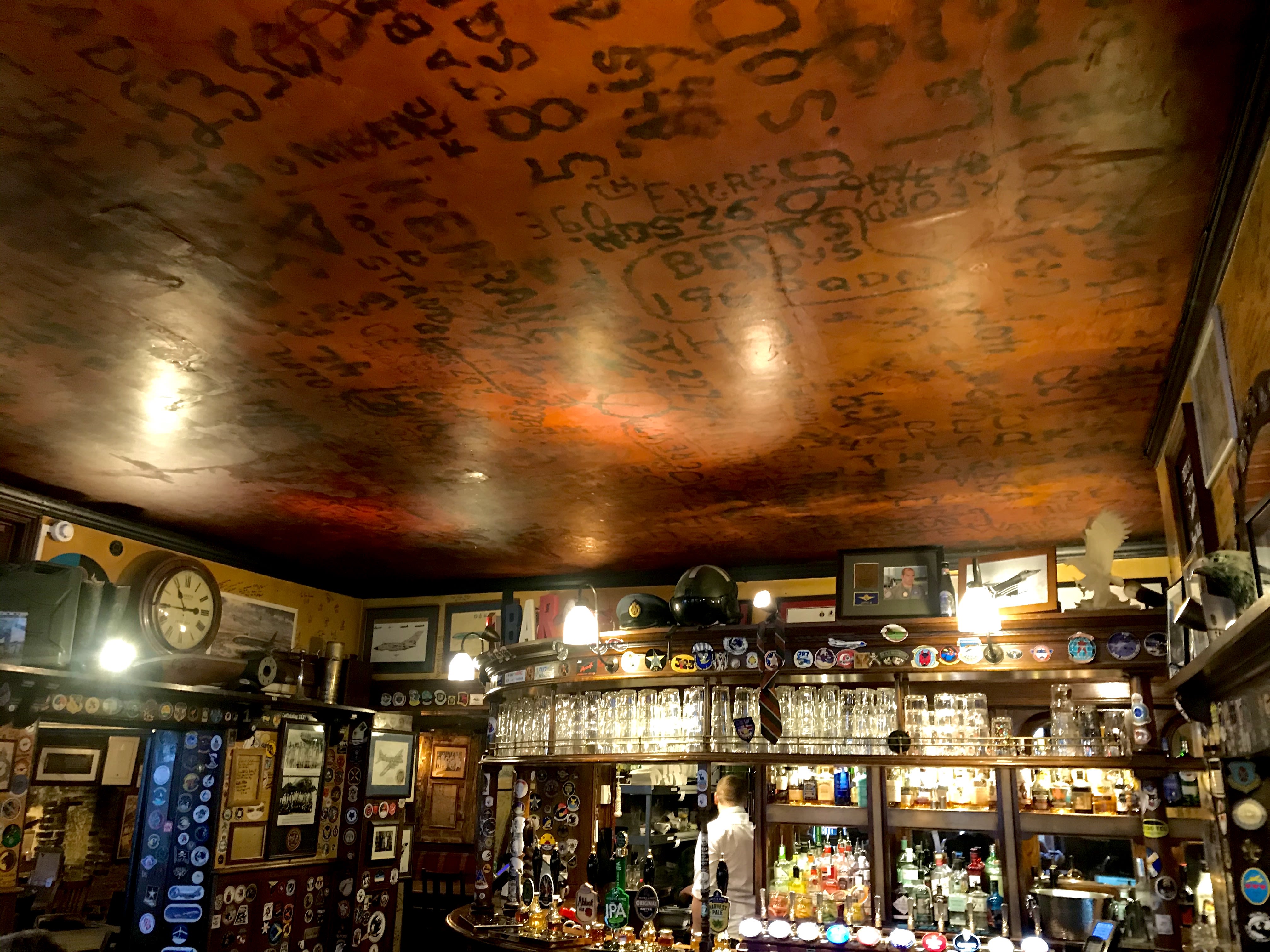
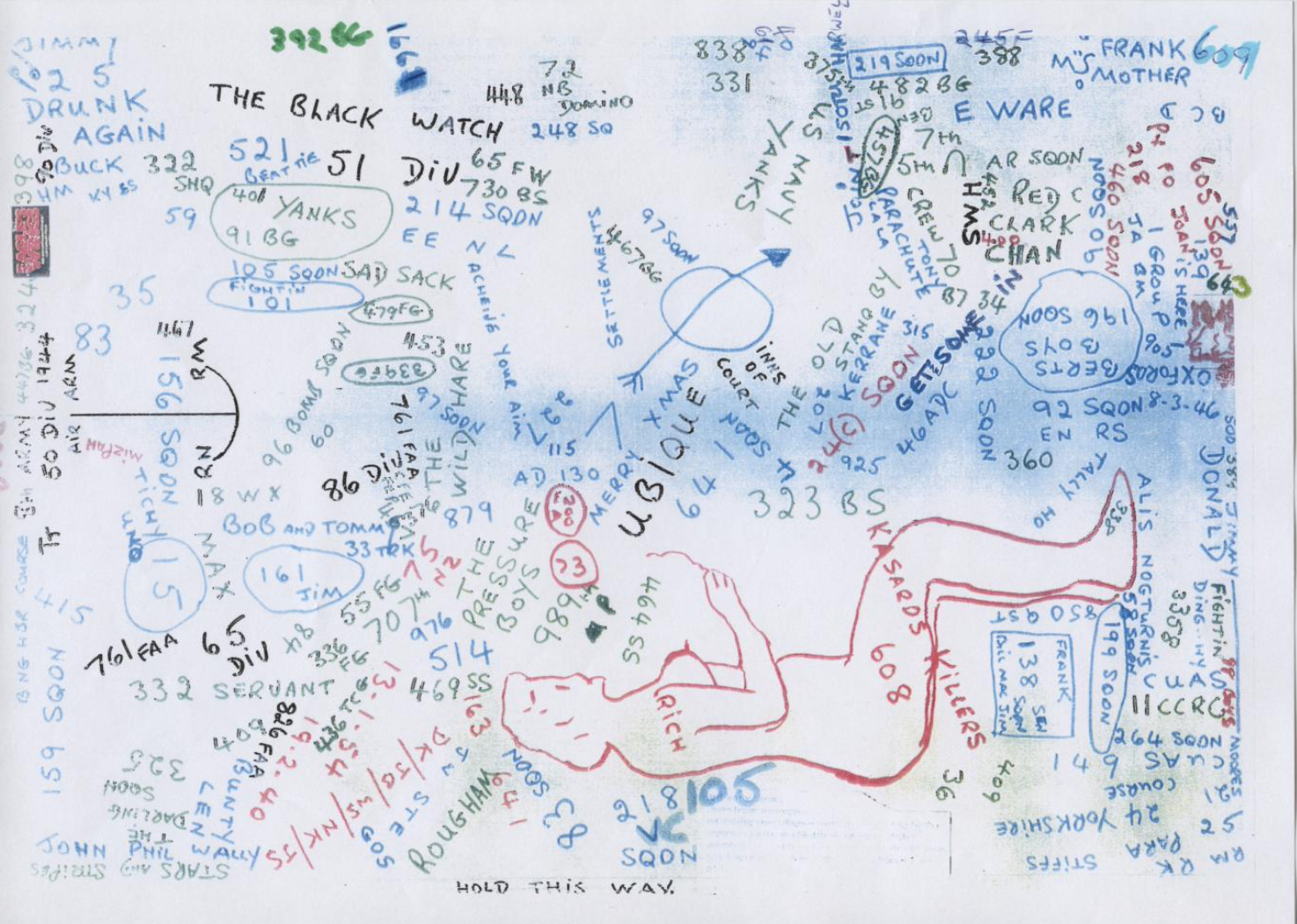
The war ended and with the passing of time and the atmosphere caused by constant smokers, the ceiling became covered in nicotine deposits and its dark brown surface, occasionally treated with varnish, gradually hid the graffiti. In the late 1980s a pub regular, Former RAF Chief Technician James Chainey, who served from 1943 to 1969, took on the mammoth task of deciphering the scrawls and researching their meaning. He managed to identify the numbers of dozens of squadrons, units, mottos, personnel and badges. James then set about recording every inch of the ceiling and deciphering all the units. His plan of the ceiling is below.


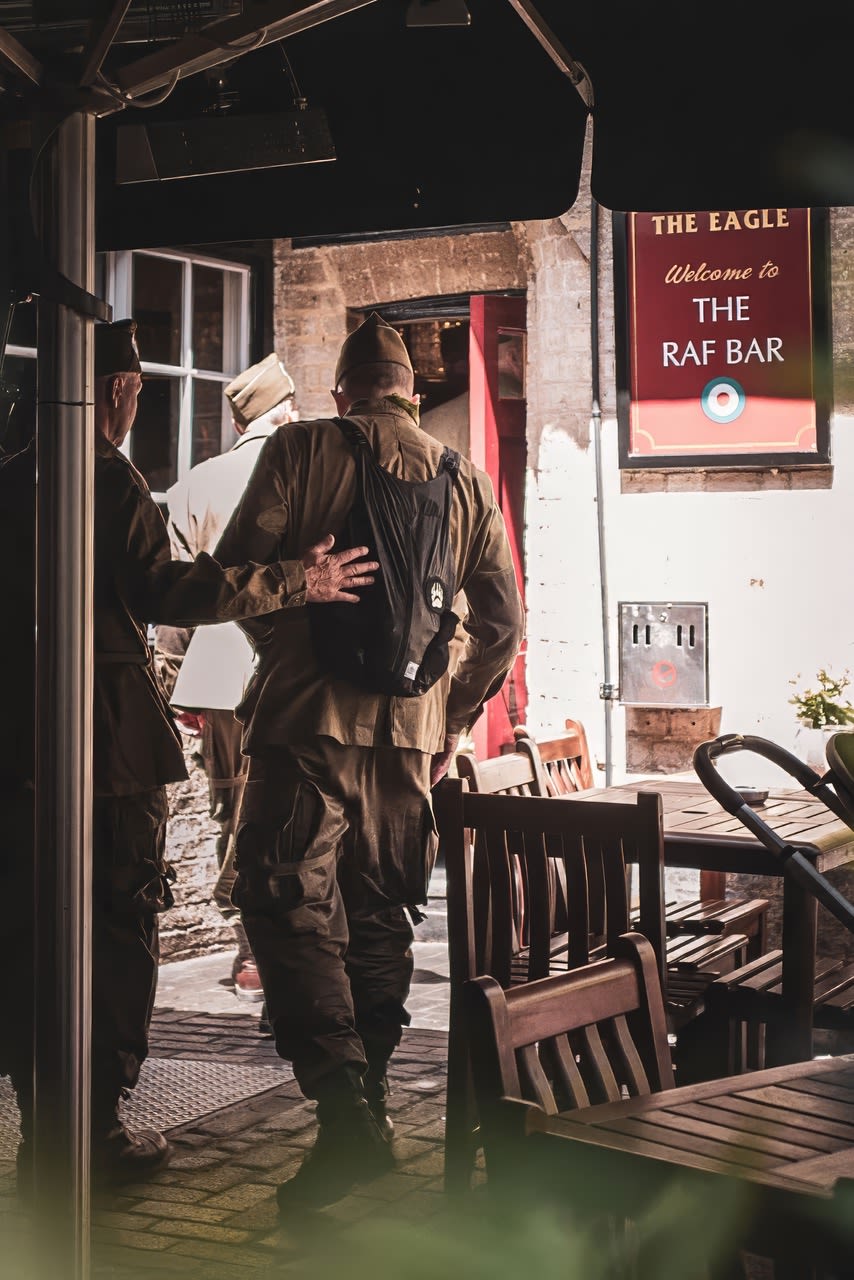
Three members of the current US Air Force visiting the RAF Bar. Photo by Martin Bond.
'The Secret of Life'
The Cavendish Laboratory behind the College on Free School Lane has an extraordinary history of discovery and innovation in physics since its opening in 1874 under the direction of James Clerk Maxwell, the University’s first Cavendish Professor of Experimental Physics.
In 1953, working together at the Cavendish, Francis Crick and James Watson determined the double-helix structure of the DNA molecule, building on the work of Rosalind Franklin, Maurice Wilkins and Cavendish colleagues. Crick and Watson were awarded the Nobel Prize in Physiology or Medicine in 1962 for discovering the 'secret of life'.
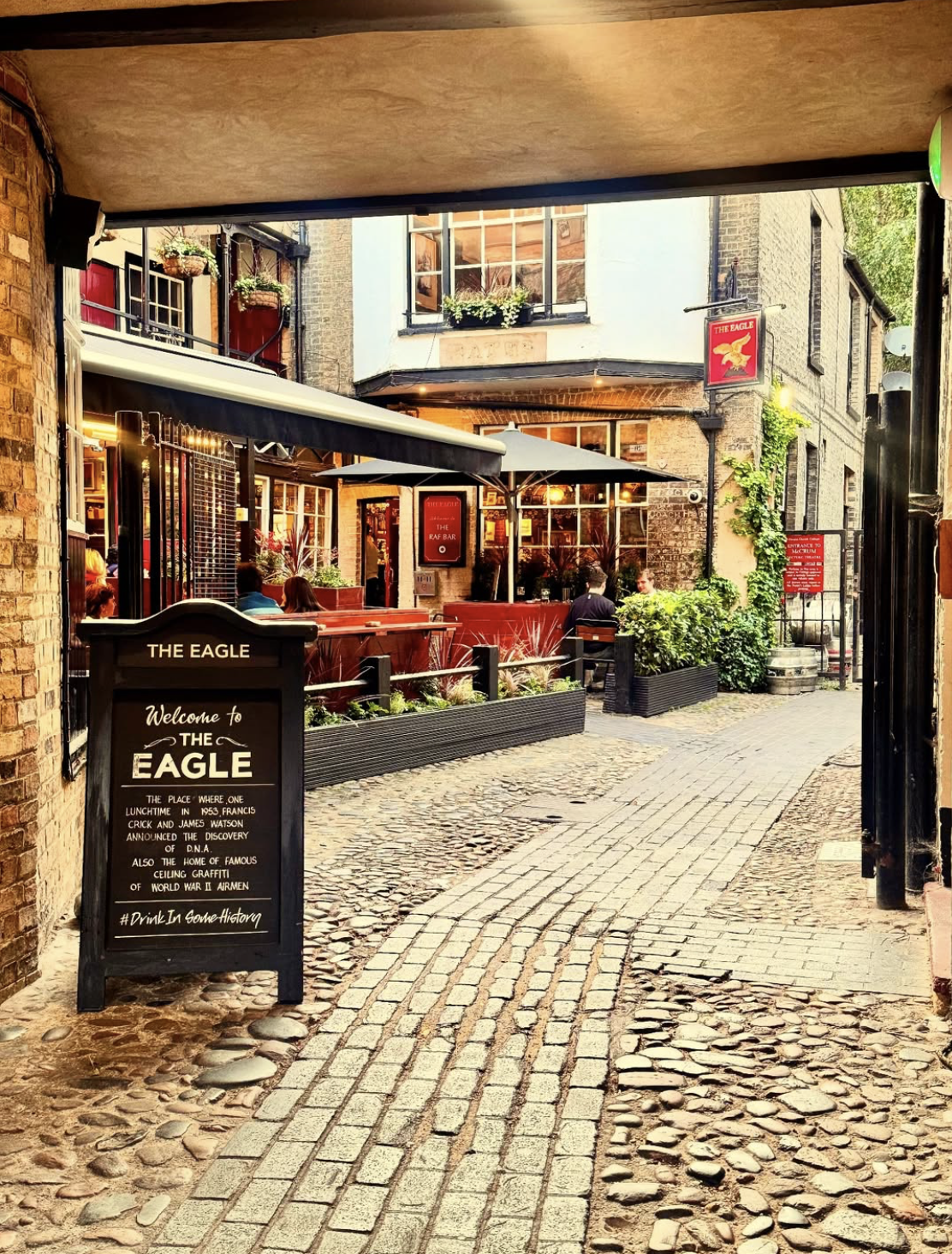
The Eagle was a popular lunch destination for scientists and staff from the Cavendish. Thus, it became the place where Crick interrupted patrons' lunchtime on 28 February to announce that he and Watson had “discovered the secret of life” after they had come up with their proposal for the structure of DNA. The anecdote is related in Watson's book The Double Helix and is commemorated on a blue plaque next to the entrance, and two plaques in the middle room by the table where Crick and Watson lunched regularly. Today the pub serves a special ale to commemorate the discovery, dubbed ‘Eagle's DNA’.
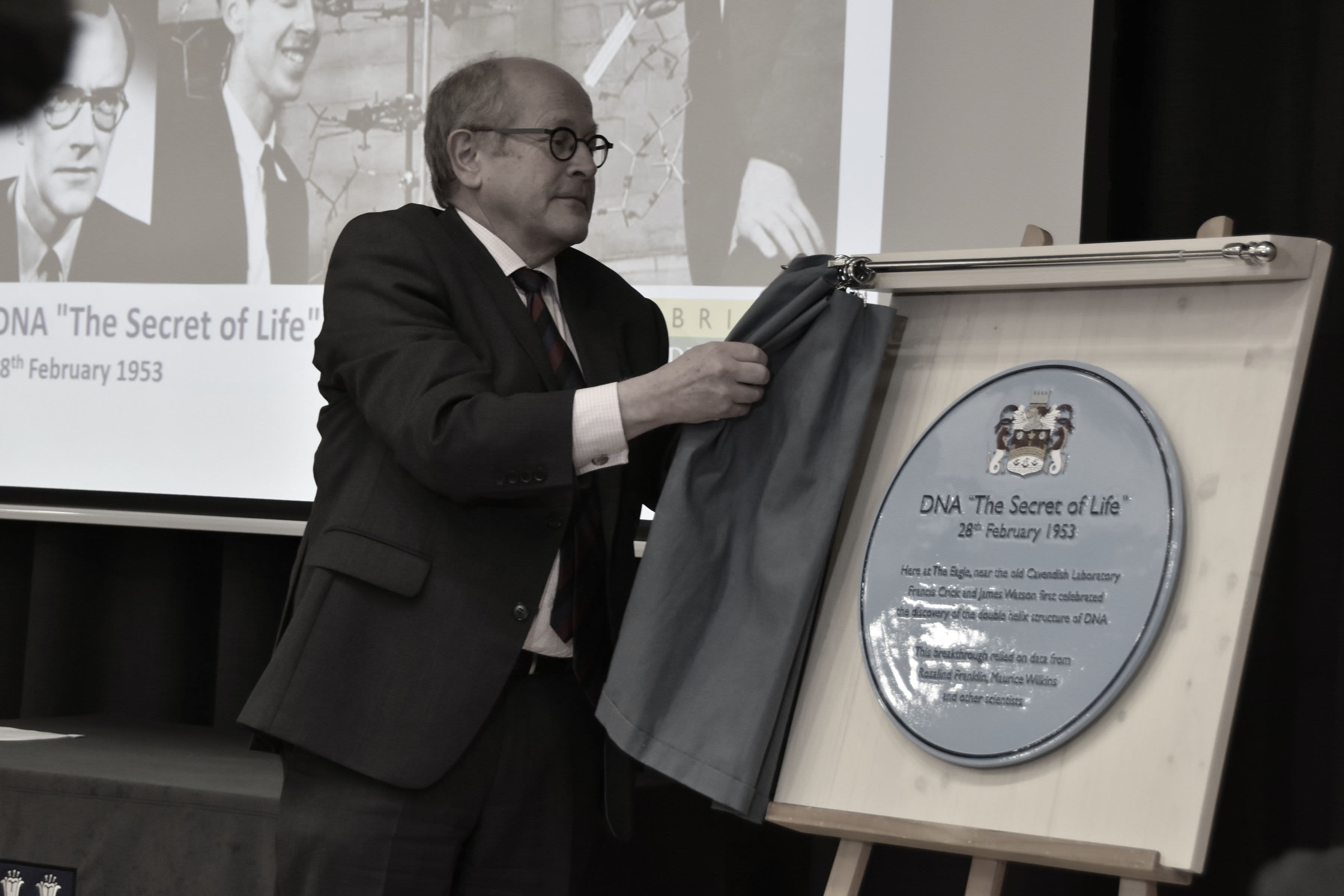
The original plaque that credited Crick and Watson with the discovery did not acknowledge the contributions of Rosalind Franklin and Maurice Wilkins to their work, and her name was subsequently scratched onto the plaque by passersby. In 2023, that omission was rectified as a new plaque was unveiled by Corpus President Professor Chris Howe.

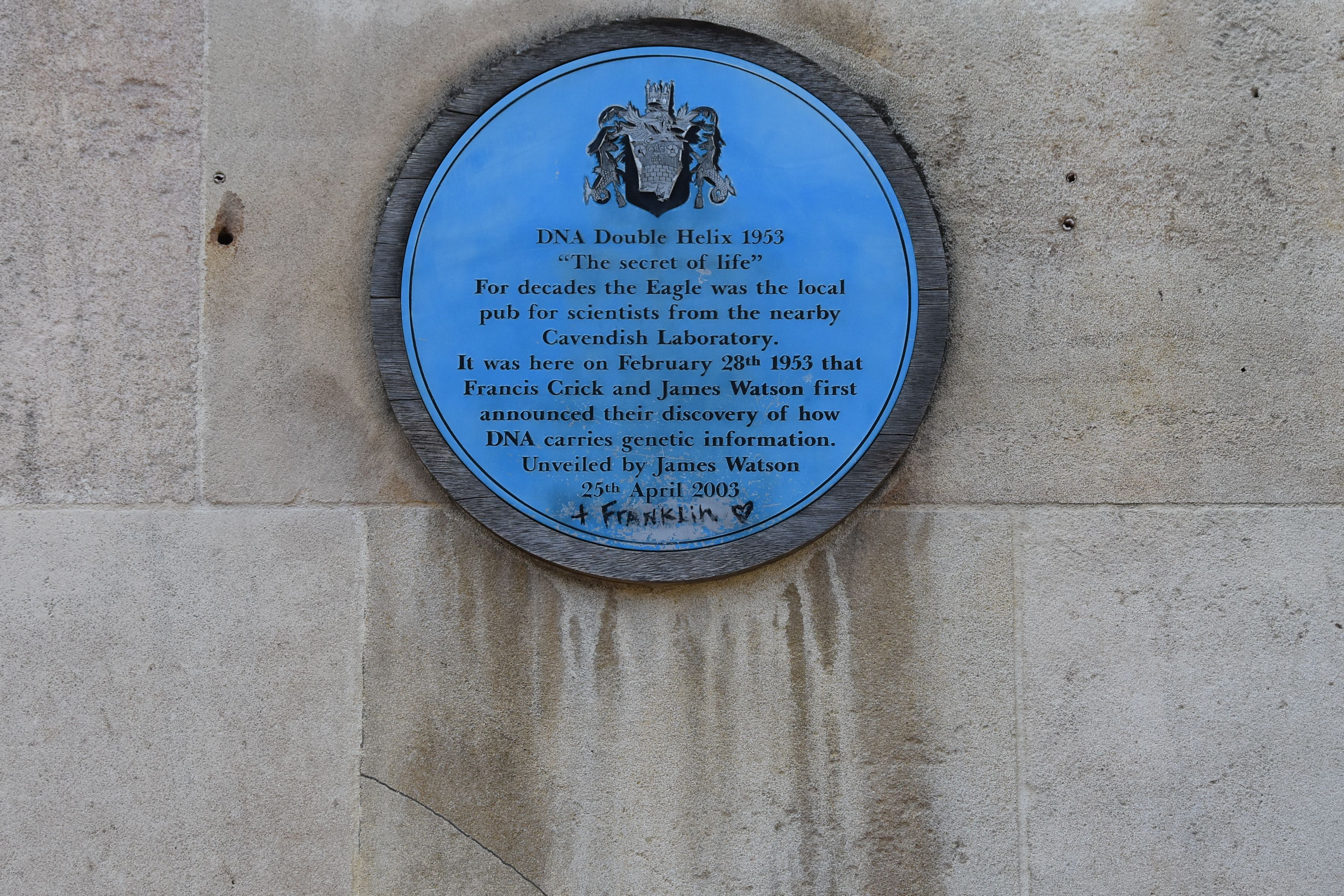
Inside the pub can be found another plaque dedicated to Crick and Watson at the very spot where they made the announcement. The end of the plaque reads, “Throughout their early partnership, Watson & Crick dined in this room on six days every week”, and the original bench still sits in situ.

The building through time
The buildings of the Eagle have been much altered over the years, but many original features still remain. There are two main areas - the Street Range on Bene’t Street and the Yard Range behind. During renovations of the Eagle in the late 80s, College Fellow Oliver Rackham wrote in detail about the structure of the building through time. What follows is excerpted from those writings.
This is a rare example of a purpose-built inn of Shakespeare's time, and a relatively rare survival of a lower-middle-class urban building. It contains a remarkably wide range of timbers. It has excellent surviving examples of early interior decoration. It has one of the earliest cellars in Cambridge outside the colleges, with a fireplace.
The building is of four storeys — cellar, ground floor, first floor and garrets. Originally it was almost entirely timber-framed and had three rooms on each floor (except the cellar), with the chimney stack between the north and middle rooms. The gallery, which runs along the yard side at first-floor level, connects the three upstairs rooms and the stairs of the Yard range. The plan is an odd shape, neither square nor straight, with a bend in the alignment where the south rooms align. This is common in tightly-packed towns, in which buildings were rebuilt one by one and had to be fitted into awkward spaces between neighbouring buildings. The Eagle was meant to be seen from the Yard, the doors and all the large windows are on this side.
The differences between the Street Range and the Yard Range result mainly from different materials and social status and indicate no great difference in date. The Yard Range was comfortable but unpretentious and in the vernacular tradition. The Street Range was meant to look like a Baroque country house.
In the 16th century, Cambridge was even less well supplied with woodland than it is now; yet almost every house was timber-framed. How (and why) was this done? The Eagle provides a rare opportunity to study the materials of an Elizabethan house in an area without a woodland.
In Cambridge, oak would have been brought from a distance. The commonest timber in the building is reused oak from various medieval buildings; the joints suggest a range of dates from the 13th century. Many of them are soot-blackened, indicating that they previously formed the roof of a hall-house heated by a central hearth. Other reused timbers come from floors and other components of medieval buildings (one rafter was made out of a chopping block). Other wood includes elm, aspen and pine. Wattle-and-daub infill between the wall timbers are hazel, ash and sallow, with some maple and aspen.
Much survives of the original pine floorboards on all three floors. They are very wide and thick and left round underneath. Contrary to medieval practice, the Eagle has always had ceilings. The ground-floor ceilings appear to be original and are formed on a layer of reeds trapped above a batten nailed under every joist.
In three of the four surviving main rooms, several square feet of painting are preserved. The paintings are in three layers, representing successive redecorations; the exposed layer is the last redecoration before the fashion for wallpaper came in. In the north first-floor room, I counted nine layers of wallpaper plus three layers of paint. [Note, sections of painted wall can be seen behind glass in the building today.]

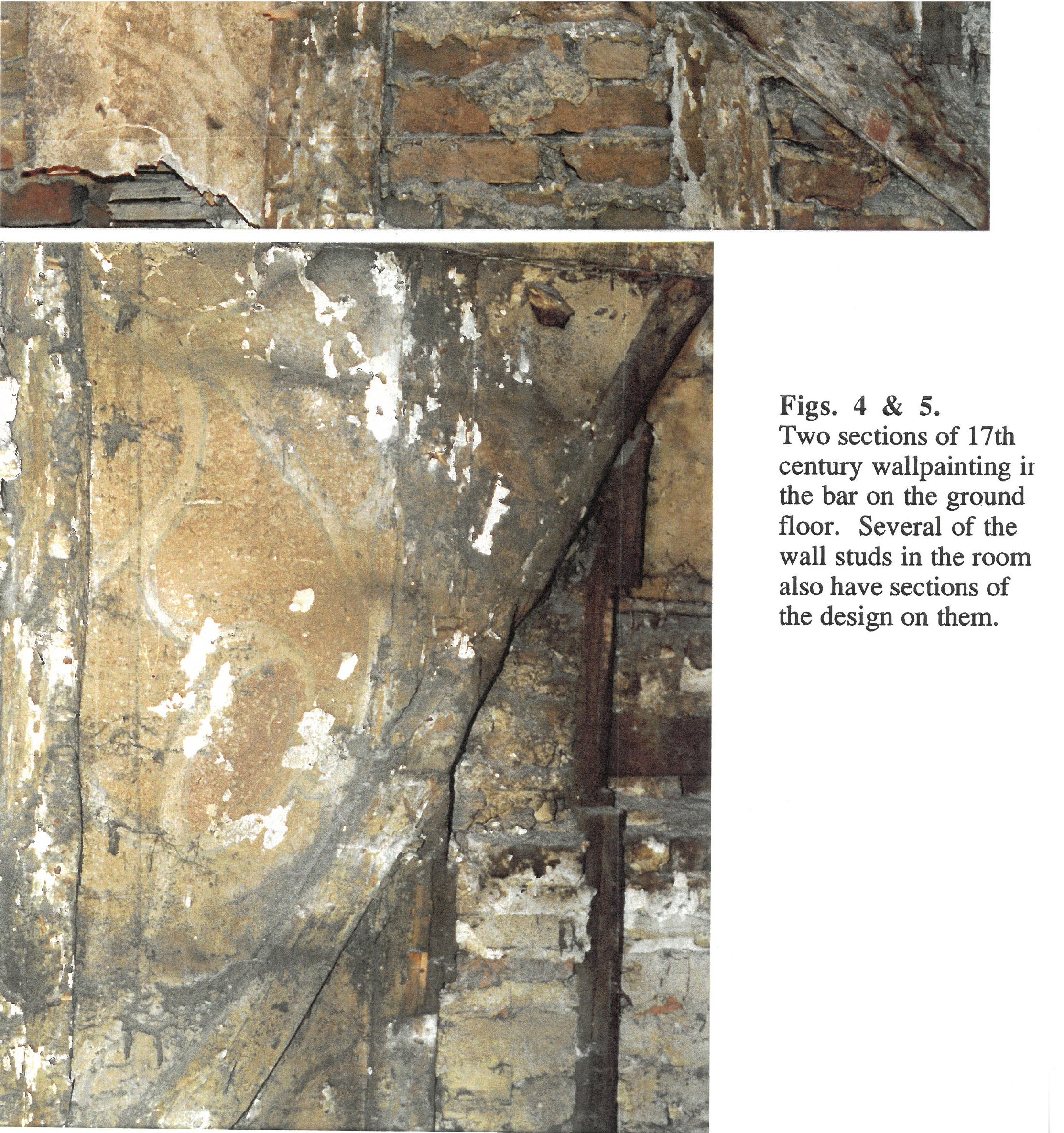
In the mid-17th century, the fortunes of the inn suddenly rose and the Street Range was rebuilt with a fashionable and imposing brick facade. But during the 18th century, as the inn's status declined in status to a tavern, there was little alteration, although a second cellar was dug under the Yard Range and a passage tunnelled through the base of the central chimney to enable barrels to be dragged into the middle cellar. There were some alterations to the windows and smaller fireplaces were inserted inside the original ones, probably to burn coal instead of mixed fuels.
A further expansion in the 1820s brought the Eagle to the height of its fortunes. The Street Range was refaced, partitions were removed to create a huge banqueting room and even smaller fireplaces were nested inside the previous ones. When the foundation stone of Corpus’ New Court was laid in 1823, a substantial dinner was held for 170 workmen at the ‘Eagle tavern’. During this period a tenement was added onto the west of the main building and the whole new front pointed with Ketton stone.
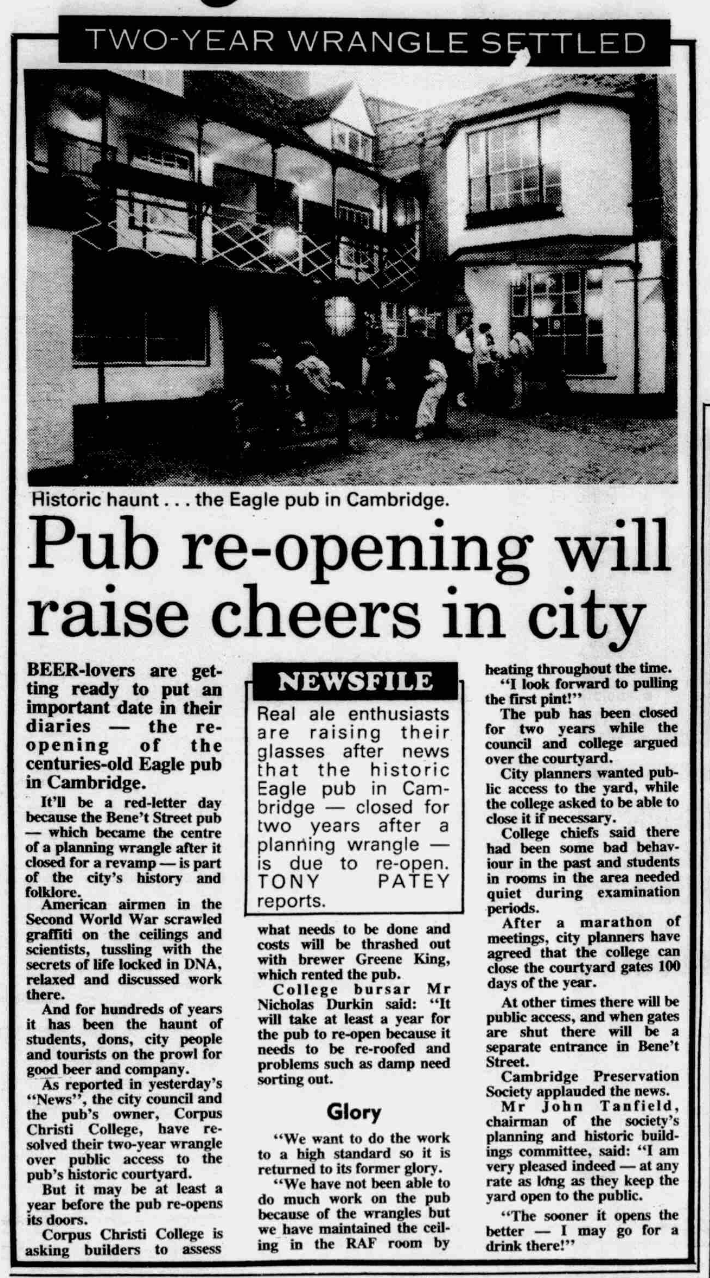
Under the Bursarship of Patrick Robert Stopford in the late 1980s, there were major building projects on and around the Eagle site. These included the refurbishment of many associated buildings together with the construction of the Beldam building and the McCrum Theatre. The works also included the restoration and conservation of the Eagle, in association with Greene King. Whilst the pub was closed from 1988-92, the number of bars was increased from three to five by re-establishing the Street Range, and there was major reconstruction of the galleried walkway and the roof, and redecoration of the interior.
The Eagle was officially reopened in 1992 by the Master Michael McCrum. In 1993 the David Urwin award for Best restoration, extension or alteration of an existing building was given to Nick Cannell, Greene King & Co. Architects, and John Wisbey, Ison Wisbey Associates.

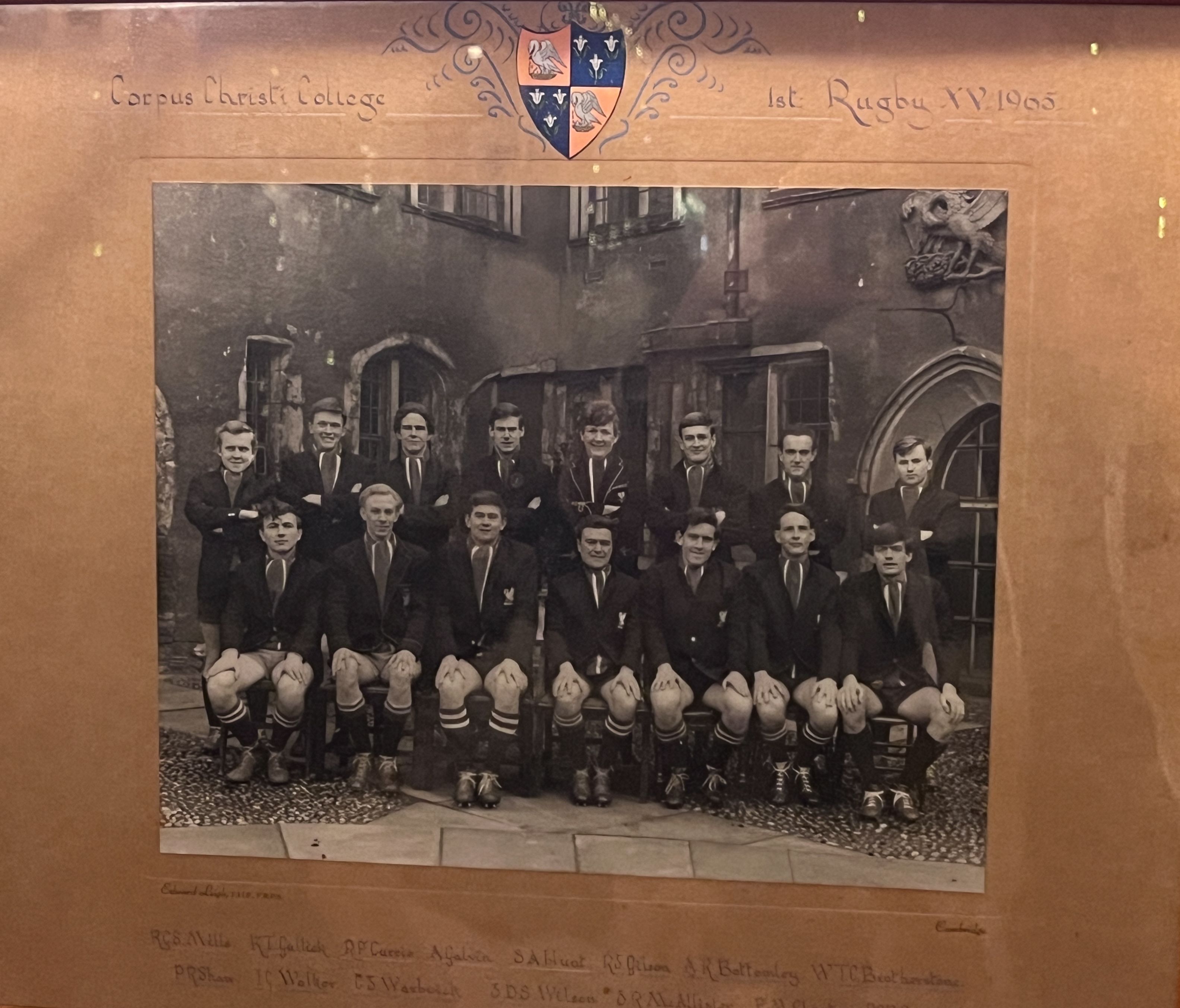
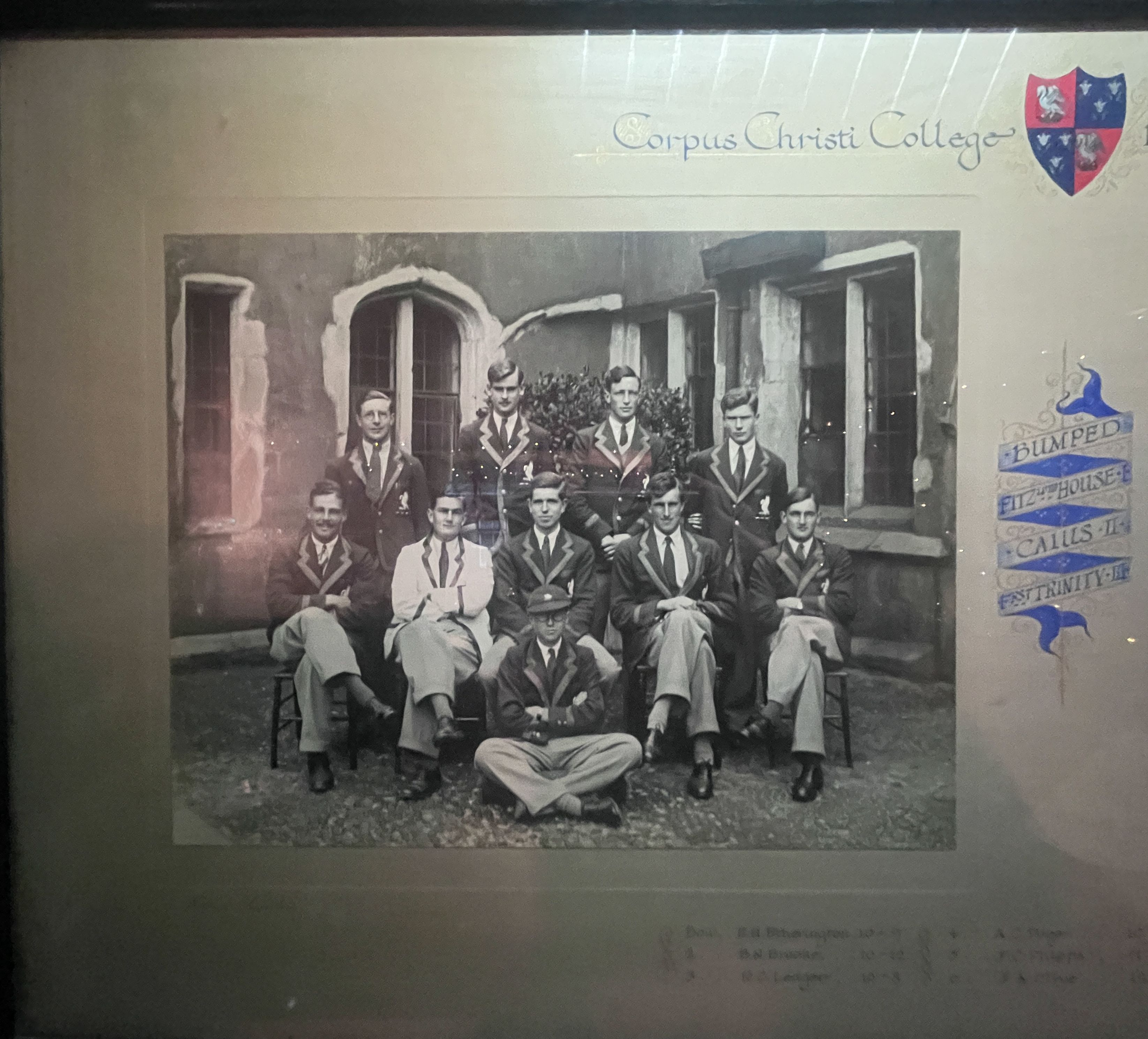
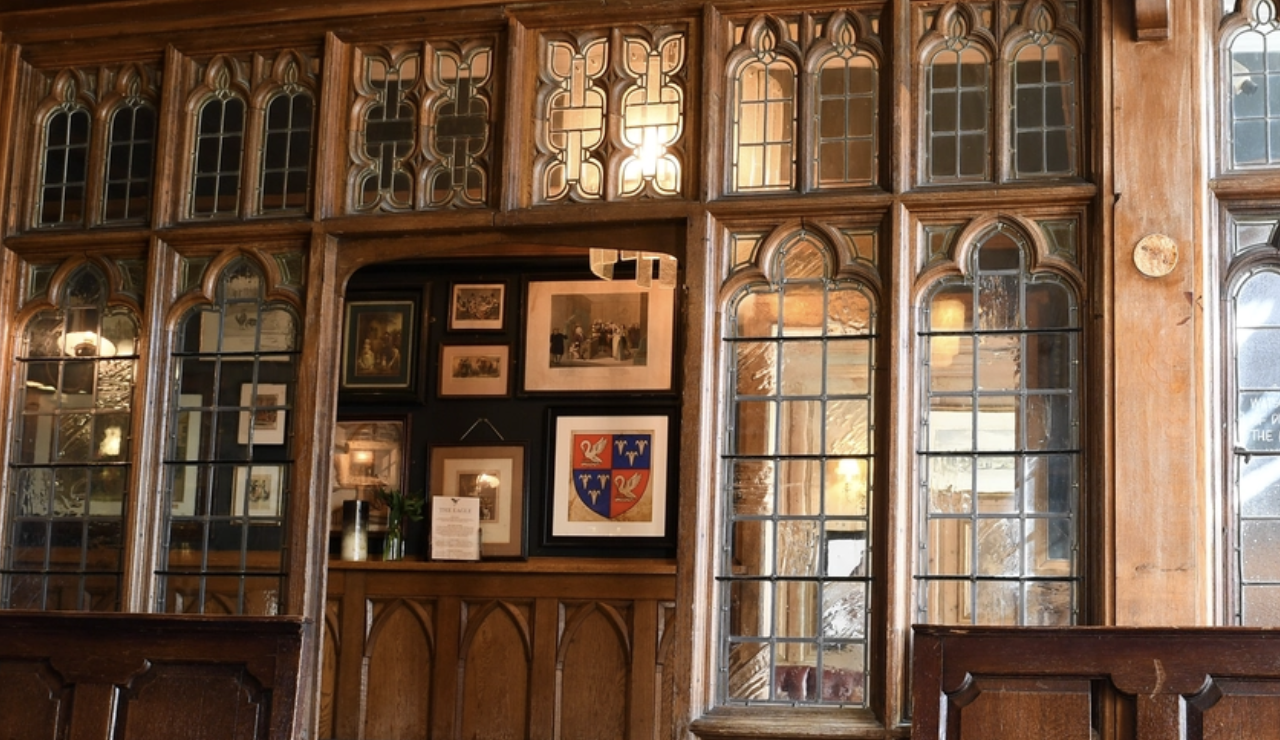
Corpus memorabilia in the Eagle




References
1. Cambridge Past, Present and Future: Blue Plaques. https://cambridgeppf.org/john-mortlock/
2. Allen, Martin and Briggs, C. Stephen. The Bene't Street, Cambridge, Hoard of Gold and Silver Coins of Elizabeth I, James I and Charles I. The British Numismatic Society.2013 https://www.britnumsoc.org/publications/Digital%20BNJ/pdfs/2013_BNJ_83_13.pdf
3. Edwards, David N. Excavations at Bene't Court, Cambridge. Cambridge Archaeological Unit, University of Cambridge. November 1996. Report 184.
https://doi.org/10.17863/CAM.103385
See also Luff, R M; Moreno-Garcia M. Killing cats in the Medieval Period. An unusual episode in the history of Cambridge, England. Archaeofauna 4: 93-114. 1996.
5. Osborn, Malcolm. A famous ceiling. 398th Bomb Group Memorial Association. http://www.398th.org/PDF/Friends/Osborn/Osborn_A%20Famous%20Ceiling.pdf
 Built with Shorthand