
Distillation meets Discovery
Corpus PhD student William Lowe delves
into the science behind every sip
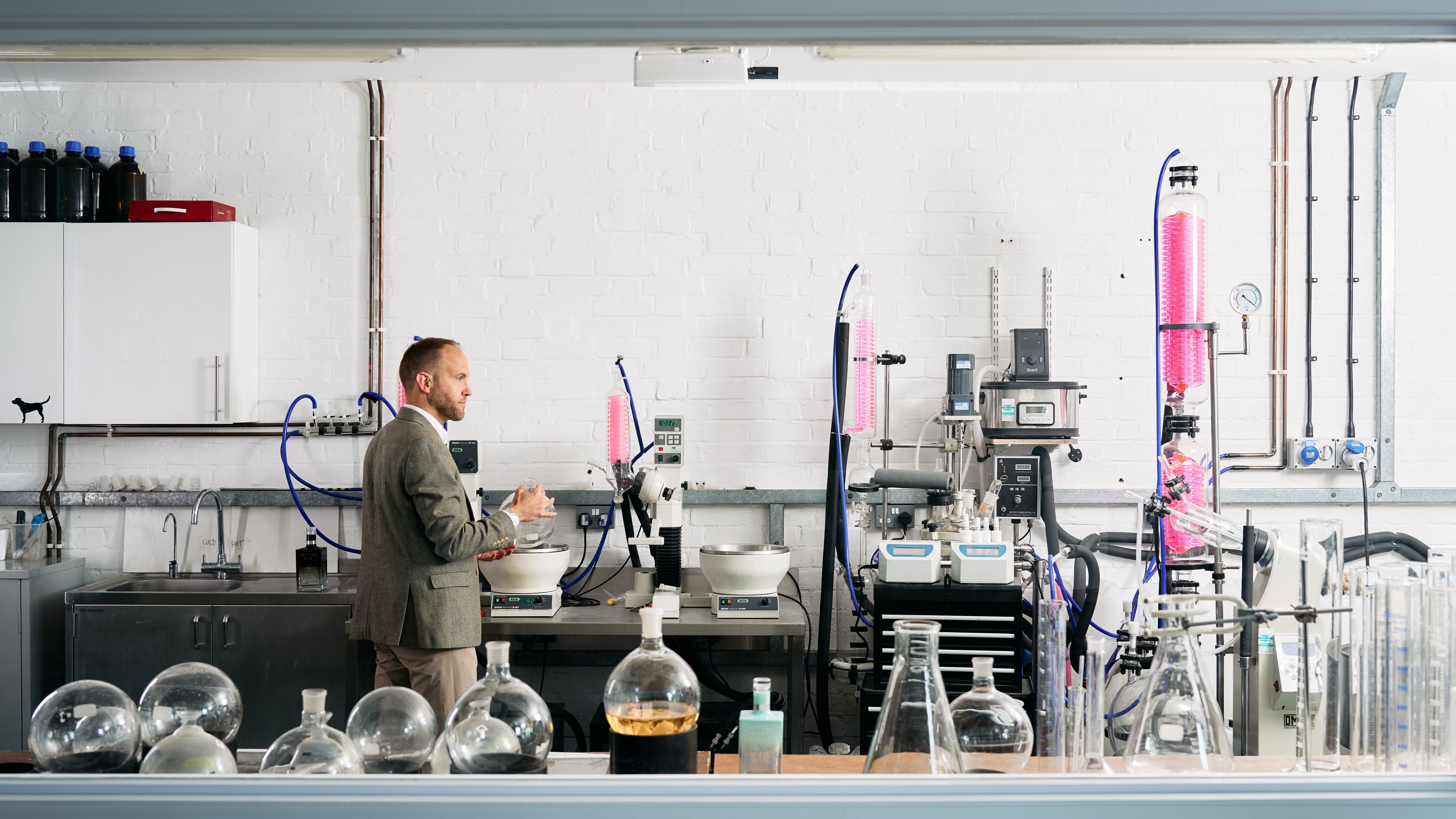

As a new documentary is released featuring the Master Distiller and co-founder of Cambridge Distillery – who also happens to be a PhD student at Corpus – we caught up with William Lowe to find out more about his research into the chemistry of alcohol and the challenges of studying part-time.
The documentary, Drink: A Look Inside the Glass, explores the relationship between alcohol, the land it comes from and its premier makers. Each episode features a different kind of drink and its producer as they reveal the history, process and craft that goes into every bottle. Will is profiled in Episode 4: Gin, portions of which were filmed at Old House and Leckhampton in 2022. You can watch the trailer below.
The documentary has been released worldwide through Apple TV, Prime Video, Tubi and Roku, and has won several awards, including the James Beard Award for Best Travel Visual Media, Webby Award for Best Food and Drink Series and three Telly Awards for Best Non Scripted Series, Best Food and Drink Series and Best Documentary Series.
Q & A with Will Lowe
You started your PhD on a part-time basis in 2021 in the Department of Chemical Engineering and Biology. What is the focus of your research?
My work explores the intrinsic physicochemical properties that underpin perceived quality in wines and spirits, and how those liquid parameters map onto the way we describe and experience what’s in the glass. In other words, I’m trying to build a quantitative bridge between the molecules we can measure and the sensory experience we use to judge quality. I’m supervised by Dr Sebastian Ahnert whose work in the analytical side of flavour chemistry first captured my attention back in 2011.
Has anything like this kind of research been done before?
Pieces of the puzzle exist – separate studies in analytical chemistry, sensory psychology and marketing – but nobody has yet combined them to create a predictive model that works across both wine and spirits. The novelty of this research lies in bringing those disciplines together and validating the model with real-world tasting panels that range from beginners to Masters of Wine-level experts, as well as exploring the ‘semantic structure’ of perceived quality (i.e., the individual elements in consideration when making overall quality assessments).
What kinds of scientific techniques and instrumentation do you use to measure the physiochemical properties you described? How do you map them to the subjective experience of taste and aroma?
I’m using analytical chemistry methods, which include gas chromatography and proton transfer reaction mass spectrometry. To bridge the gap between molecules and perception, I’m correlating these (huge) data sets with structured tasting assessments using expert panels who rate samples on specific dimensions of quality (e.g., balance, length, intensity, complexity, and typicity). Statistical modelling with principal component analysis and regression techniques help map these physico-chemical profiles to sensory perceptions. It’s essentially a translation exercise: turning hard data into human experience, and vice-versa.

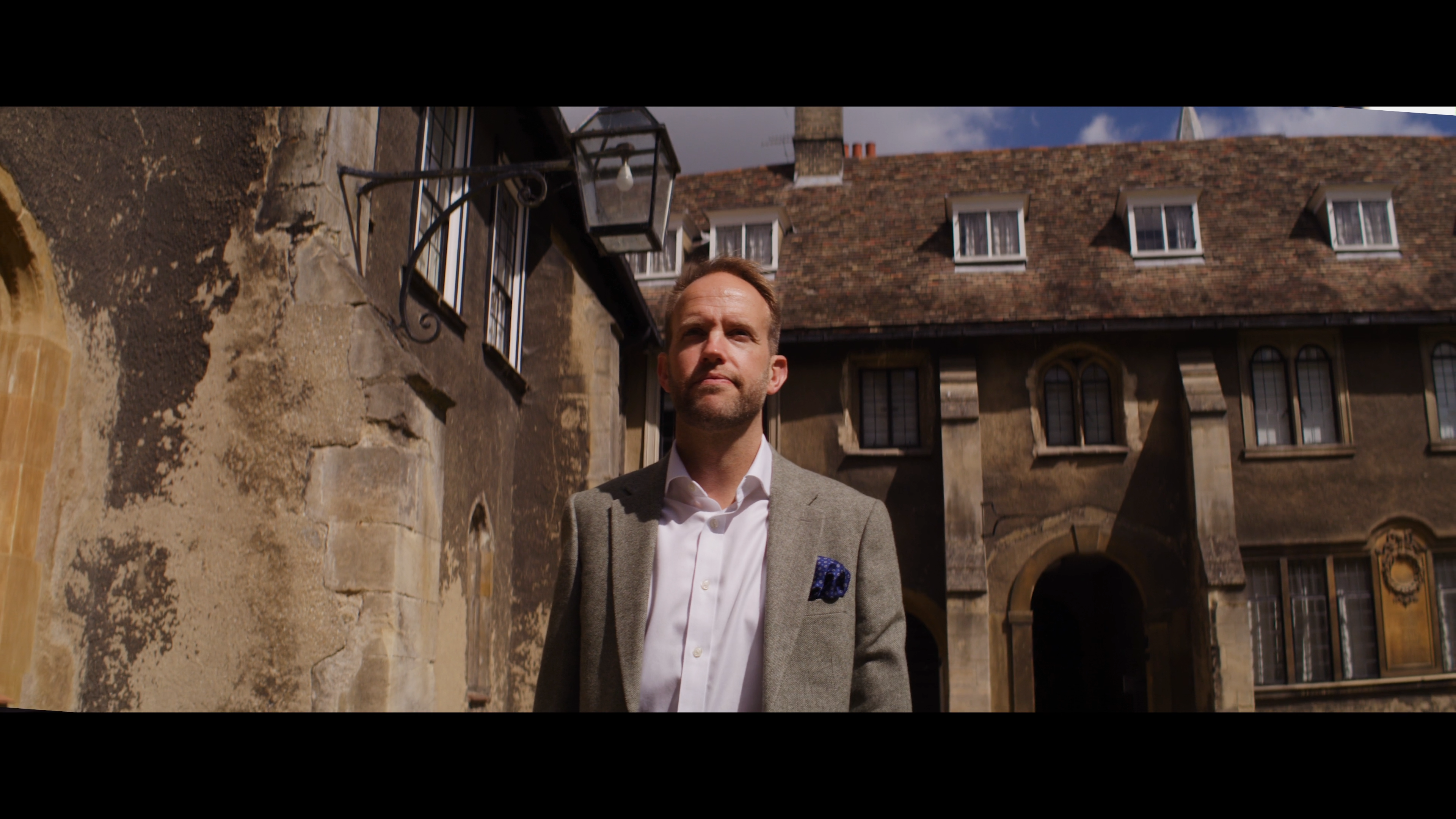
A still from the documentary, filmed in Old Court.
A still from the documentary, filmed in Old Court.
You did your undergraduate degree in Psychology and then a postgraduate diploma in Forensic Psychology and Crime. What were your career goals at the time?
Back then I imagined a career profiling decision-making and bias in legal settings. But the sensory-science modules fascinated me: how we experience and recall events, how malleable and inconsistent those systems can be both within the same person and between different people. I realised I could apply the same cognitive approach to the drinks world (having bartended my way through my undergrad) so, gradually, the destination switched from the courtroom to the tasting room.
You are the co-founder of Cambridge Distillery, which is currently expanding to the United States and the Bahamas. Considering that you are working on your PhD part-time, the obvious question is how do you juggle your research, running a very successful business and family commitments?
Three things: discipline, delegation and dovetailing. Neither my research nor professional workload is evenly spread, so week by week my schedule changes and flexes to optimise the time I have available. At Cambridge Distillery we’ve built a phenomenal team, so I focus on the creative and technical decisions while my colleagues handle operational and logistical elements. Crucially, my research and the business are very much complementary – and our company is a family business, so all three elements are very supportive of each other.
We don’t have a lot of part-time PhD students. Would you recommend it?
Absolutely – if your research aligns with your professional life. A part-time doctorate demands ferocious time-management over a significant period, but the cross-fertilisation of ideas is priceless. If the two worlds pull in opposite directions, though, I’d advise going full-time so you can really apply the focus required.
You’ve also been involved with the Cambridge Wine-Tasting Society, leading them to Varsity victory in 2022.
Yes, the Blind Wine Tasting Society. It’s literally competitive tasting: using the characteristics of a wine that you can see, smell, taste and feel to determine its provenance, grape variety, wine-making techniques and maturity. Again, a huge cross-over with both my research and professional life, so I was very happy to share some of my experience and play a small role (they did all the hard work!) in their Varsity victory against Oxford. It’s genuinely impressive how well the team can taste with such relatively short experience.
You’re an athlete as well. Tell us about playing ice hockey for Cambridge University.
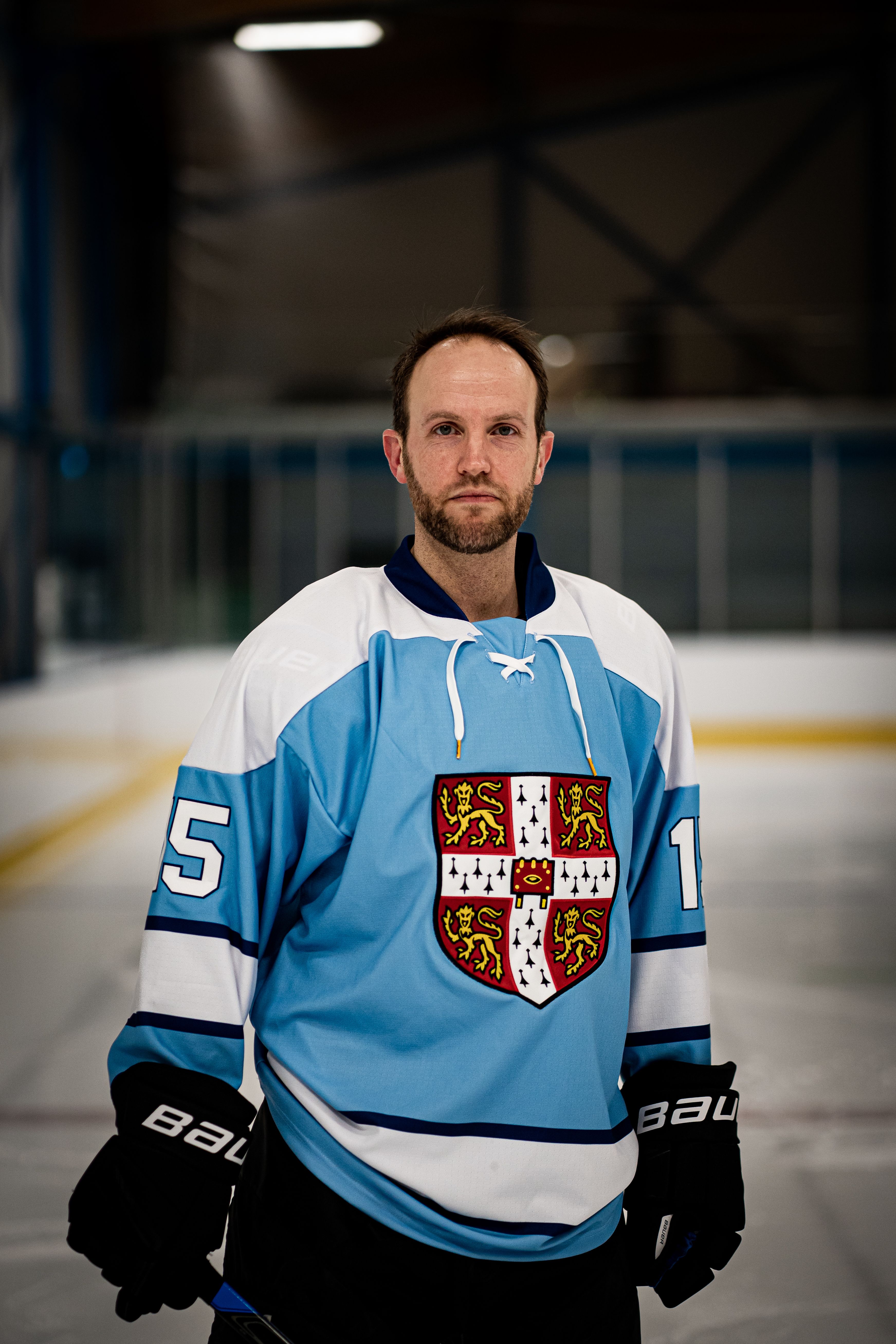
Yes – I absolutely love playing with the Huskies. Ice hockey is a brilliant sport – I played a lot of roller hockey when I was the same age as most of the current Huskies but back then there wasn’t an ice rink in Cambridge! I’ve thoroughly enjoyed team and am proud to report that we’ve lifted the trophy in both Varsity games I’ve played in!

It’s very unusual to be a Master of Wine (MW) and Master Distiller. How do these qualifications differ (in addition to concerning different types of alcohol)?
The Master of Wine is a formal qualification, earned through years of rigorous study in viticulture, winemaking, global wine trade, and – famously – blind tasting. Master Distiller, by contrast, isn’t a certification but a title earned through experience. You begin as a distiller, progress to Head Distiller when you're leading others, and Master Distiller when you’ve trained someone who has themselves gone on to train another – becoming, in effect, the “grandparent” of a new generation of distillers. I was awarded the MW in 2020; becoming the first (and currently only) Master Distiller to do so.
Your partner and co-founder is Lucy Lowe. What different skills does she bring to your joint work? Is she also tempted to do a PhD?
Lucy is really the brand heartbeat of Cambridge Distillery. Her background in luxury branding and marketing means she has an instinct for storytelling and customer experience, while her palate keeps my more esoteric ideas grounded – hence the punt-tasting sessions for new launches like the Darwin Gin featured in the documentary. At the moment she’s happier steering the company’s global direction than diving into academic life, but never say never…!
Finally, your vision as a distiller is to use fresh botanicals from both the local area and abroad, and distill them in a very specific and intensive way. So far, the ingredients you have used range from English meadow flowers and fruits from the orchard, to truffles, wood ants, and Japanese Shiso leaf – as well as the Darwin barberry featured in the documentary. Would you consider making a Leckhampton gin?
We have actually done this already! Back in the summer of 2015 we picked Mahonia and Viburnum (which lend a rose petal and white blossom note respectively) from Leckhampton for a limited edition which was made available to Fellows and students attending the May Ball. It sold out immediately. I suspect they’re quite valuable now, if any of them have managed to survive in hidden corners of the cellar.
 Built with Shorthand